
JP Morgan 2026: Obesity & GLP-1 Therapies Take Center Stage
What the Latest Deals and Data Mean for the Future of Metabolic Medicine
The J.P. Morgan Healthcare Conference once again served as the bellwether for where biotech and pharma are headed—and in 2026, GLP-1 and obesity therapeutics dominated the conversation.
From next-generation incretin drugs to RNA-based obesity targets and ultra-long-acting formulations, this year’s announcements made one thing clear: we are entering a second (and more sophisticated) wave of obesity medicine.
Below is a concise breakdown of the most relevant GLP-1 and obesity-focused updates announced this week—and why they matter.
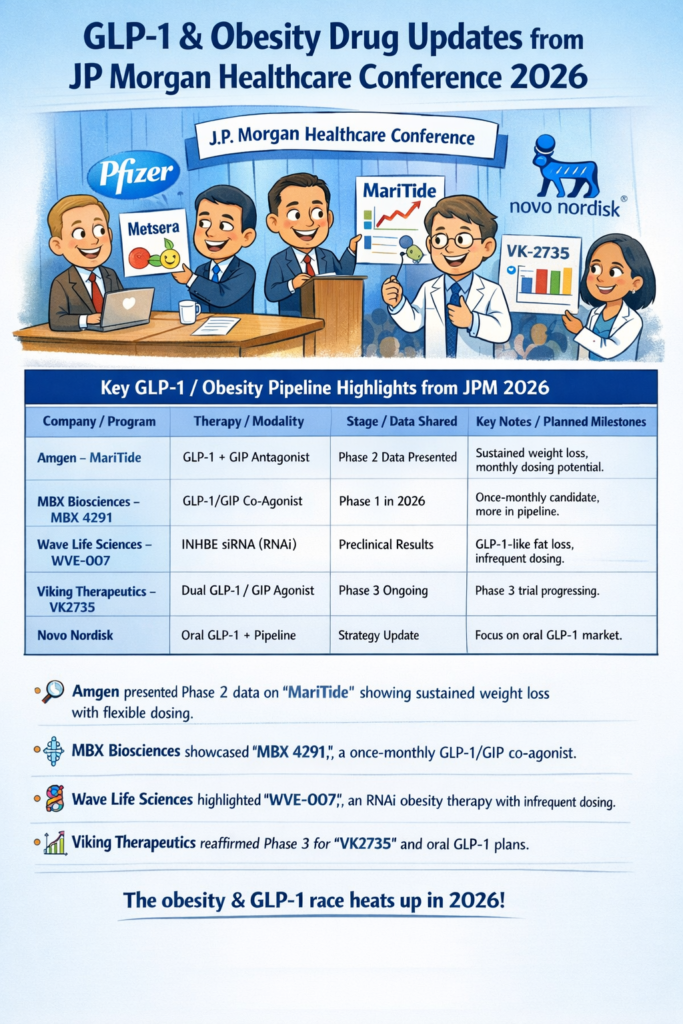
Key GLP-1 & Obesity Pipeline Highlights from JP Morgan
🔬 Amgen — MariTide
Amgen presented mid-stage clinical data on MariTide, a novel therapy combining GLP-1 receptor agonism with GIP receptor antagonism.
Demonstrated maintenance of clinically meaningful weight loss
Designed for monthly or quarterly dosing
Potential to reduce treatment fatigue and improve long-term adherence
Why it matters: The next competitive frontier in obesity care is no longer just how much weight patients lose—but how long they can stay on therapy.
💉 Viking Therapeutics — VK2735
Viking reaffirmed its Phase III VANQUISH program for VK2735, a dual GLP-1/GIP agonist, while highlighting progress on:
An oral formulation
A complementary amylin-based obesity program
Why it matters: With multiple mechanisms in play, Viking is positioning itself as a platform company in metabolic disease, not a one-asset story.
🧬 Wave Life Sciences — WVE-007
Wave introduced one of the most unconventional obesity approaches at JPM: RNA interference targeting INHBE, a genetic regulator of fat mass.
Single-dose data showed GLP-1–like fat loss
Potential for once- or twice-yearly dosing
Phase 2a multi-dose studies planned for 2026
Why it matters: This hints at a future where obesity may be treated like hyperlipidemia or osteoporosis—with infrequent dosing and long-acting control.
⏱️ MBX Biosciences — Monthly GLP-1 Prodrugs
MBX Biosciences highlighted a growing pipeline of long-acting GLP-1/GIP prodrugs, including MBX-4291:
Designed for once-monthly administration
Aims to smooth pharmacokinetics and GI tolerability
Additional candidates expected later this year
Why it matters: Convenience is becoming a clinical differentiator, not just a marketing feature.
🧠 The Big Picture
Across presentations, a few consistent themes emerged:
Longer-acting therapies are a major priority
Combination biology (GLP-1 + GIP, amylin, glucagon, RNAi) is replacing single-target approaches
Obesity is now viewed as a chronic, lifelong condition, not a short-term weight-loss problem
This evolution mirrors what oncology went through a decade ago—moving from blunt tools to precision, mechanism-driven therapies.
🎨 Cartoon Concept: “The GLP-1 Arms Race at JP Morgan”
Visual idea for the accompanying cartoon:
A conference stage labeled “JP Morgan Healthcare Conference”
Cartoon pharma executives (with generic lab coats and name badges) unveiling:
A giant syringe labeled “Quarterly GLP-1”
A calendar with only 2 injections circled per year
A DNA/RNA helix wearing boxing gloves labeled “RNAi Obesity”
In the foreground:
A classic weekly GLP-1 pen looking nervous
A scale with a speech bubble saying: “It’s not just about losing weight anymore…”
Tone: Smart, slightly satirical, visually clean—educational rather than political.
(If you want, I can generate this cartoon in a clean medical-cartoon style sized for WordPress hero images or social media.)
Final Thought
JP Morgan 2026 confirmed what many clinicians and researchers already sensed:
Obesity therapy is rapidly becoming one of the most innovative areas in modern medicine, borrowing strategies from oncology, genetics, and chronic disease management.
The GLP-1 era isn’t ending—it’s maturing.